25.5 MST Exercises
Factual
- Select all valid MSTs in the diagram below.
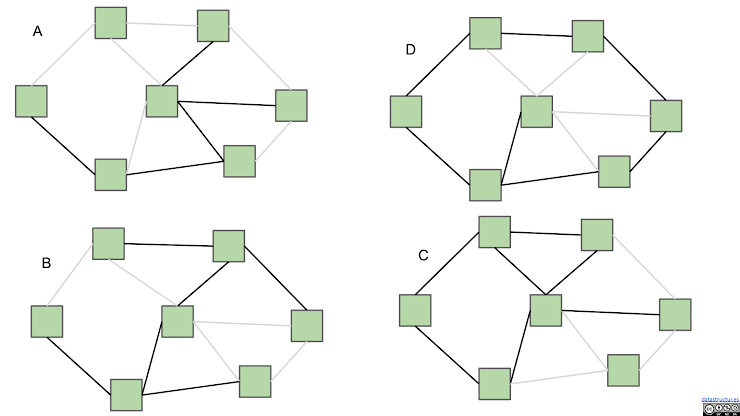
- True/False: It is possible that the only Shortest Path Tree is the only Minimum Spanning Tree.
Problem 1
Only B. C and D have cycles; A does not span all vertices.
Problem 2
True. In a tree, there is only one SPT and MST.
Procedural
- Run Prim’s from
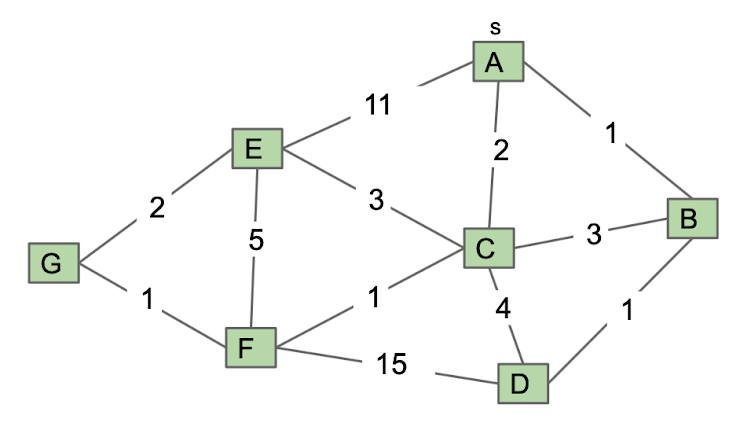
Ain the graph below. In what order are vertices visited? Break ties alphabetically. - Run Kruskal’s in the graph below. In what order are edges added to the tree? Break ties alphabetically.
- Design an algorithm to find the min-product spanning tree; ie the spanning tree with the minimum product of its edges. You may assume all edge weights are > 1.
Problem 1
Order: A B D C F G E. Prim’s repeatedly picks the lightest edge between the current tree and any node not in the tree.
Problem 2
AB, BD, CF, FG, AC, EG. Kruskal’s keeps adding the next lightest edge as long as it doesn’t form a cycle.
Problem 3
Simply take the logarithm of each edge weight, then run any MST algorithm on it. This is guaranteed to work since , and minimizing the logarithm of the product is the same as minimizing the product for positive weight edges.
Metacognitive
- If we add 1 to the weight of each edge in an arbitrary graph, will the MST created by Kruskal’s change?
- True/False: Prim’s Algorithm and Kruskal’s algorithm will always return the same result. If this is true, explain why. If this is false, provide a counterexample, breaking ties alphabetically.
- Prove the following, known as the cycle property: Given any cycle in an edge weighted graph (all edge weights distinct), the edge of maximum weight in the cycle does not belong to the MST of the graph.
Problem 1
Adding 1 to each number will not change the order of the edges when we sort them, therefore we will get the same MST.
Problem 2
False. A counterexample is the following graph:
Prim’s starting from A will select AD, BD, and CD, whereas Kruskals will select AD, BC, and BD.
Problem 3
Suppose, for contradiction, the maximum-weight edge f in a cycle is present in the MST.
Removing f disconnects our MST T. Form a cut with the two sides of the MST after f is removed.
Since f is part of a cycle, there must be also some edge e crossing that same cut. However, if we replace f with e, we now have a spanning tree that has less weight than our MST T.
This is a contradiction, so the maximum weight edge in a cycle cannot be part of the MST.