35.1 Counting Sort
Imagine if instead of driving a slow Honda Civic, we started driving a fast Ferrari. Unfortunately, we won’t actually be driving in a Ferrari today, but we will witness a blazing fast algorithm that’s just as fast called Radix Sorts.
When sorting an array, sorting requires compare operations in the worst case (array is sorted in descending order). Thus, the ultimate comparison based sorting algorithm has a worst case runtime of .
From an asymptotic perspective, that means no matter how clever we are, we can never beat Merge Sort’s worst case runtime of . But what if we don’t compare at all?
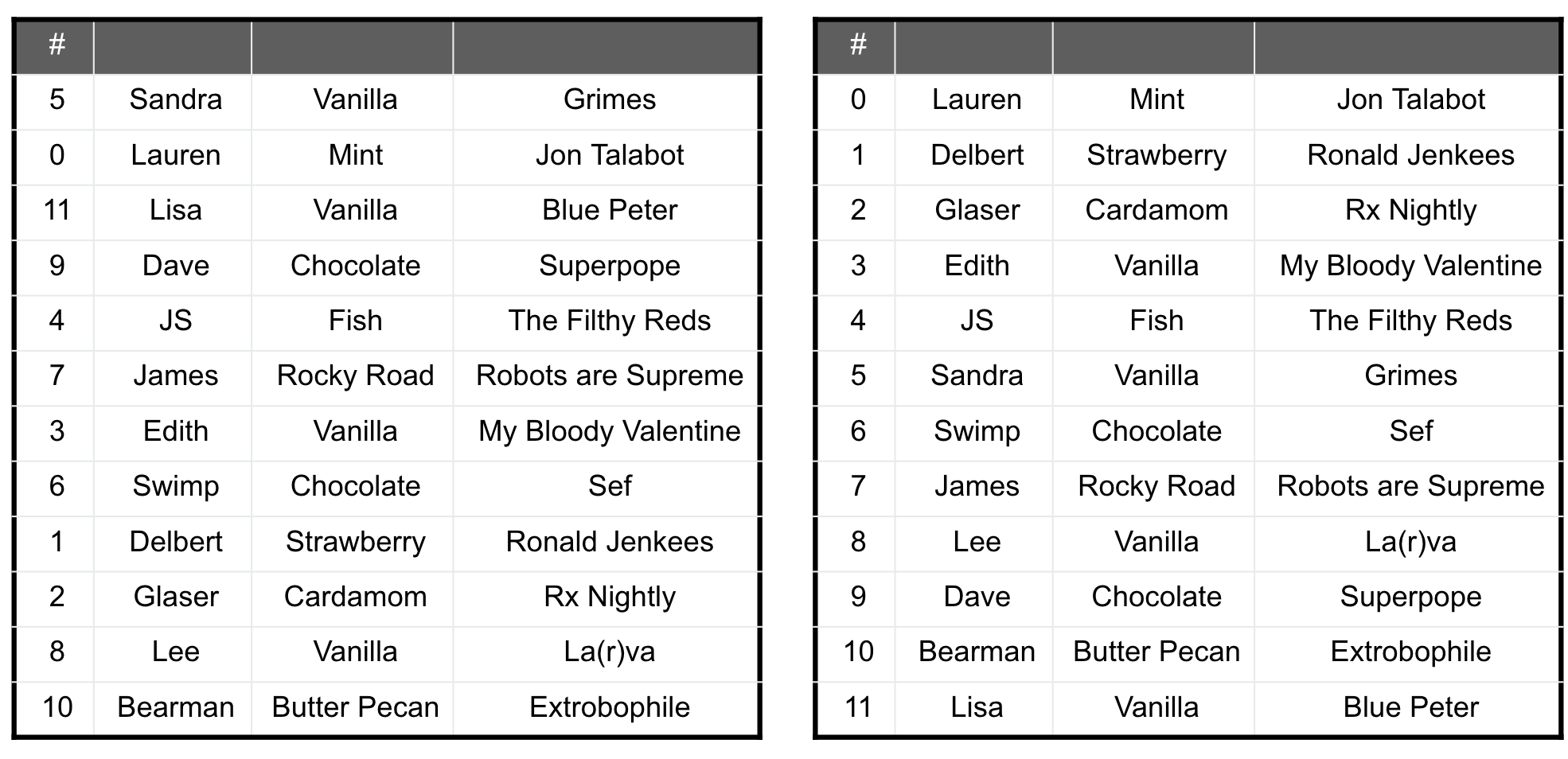
Left is original, right is ordered output
Essentially what just happened is that we first made a new array of the same size and then just copied all of the # indexes to the correct location. So first we look at 5 Sandra Vanilla Grimes and then copy this over to the 5th index in our new array.
This does guarantee worst case time. However what if we were working with
- Non-unique keys.
- Non-consecutive keys.
- Non-numerical keys.
All of these cases are complex cases that aren’t so simple to deal with. Essentially what we can do is create a simpler method which is to:
- Count number of occurrences of each item.
- Iterate through list, using count array to decide where to put everything.
Bottom line, we can use counting sort to sort objects in time.