DGEMM: SIMD with Intel Intrinsics
Learning Outcomes
- Compare SIMD-extended matrix multiplication with sequential programs.
- Compare performance using different
gccoptimization flags:-O0,-O2,-O3.
🎥 Lecture Video
Before continuing, we recommend reviewing:
- DGEMM benchmark
- Performance optimizations on a sequential program
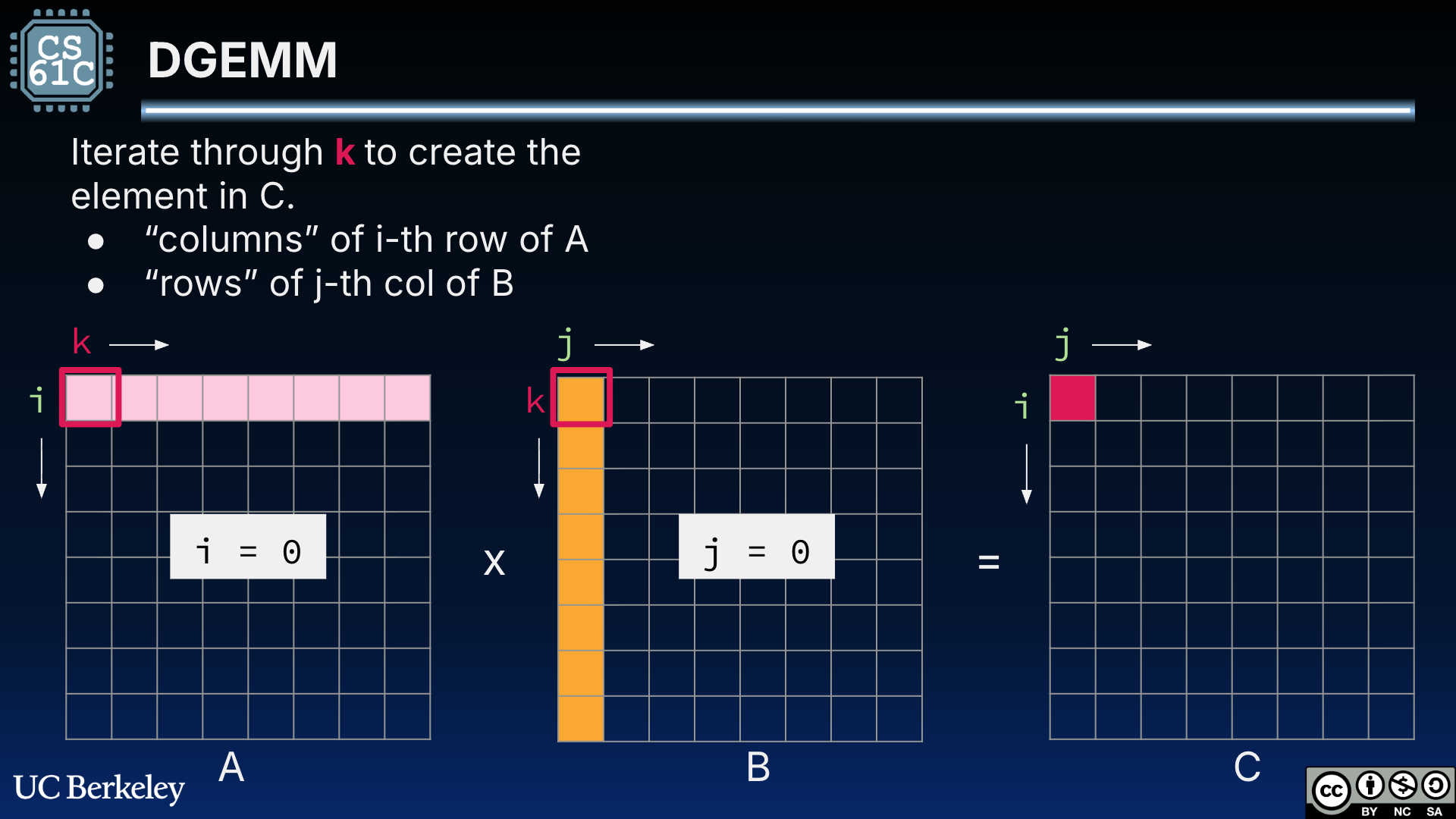
DGEMM for square matrices A and B. is computed as the dot product of row i = 0 of A and column j = 0 of B.
DGEMM 7: Naive SIMD DGEMM
With the ability to perform SIMD multiplication, it is tempting to use our new 256-bit-wide registers to load in blocks of row A and blocks of column B for the element-wise multiplication necessary for dot products, as shown in #fig-dgemm-simd-naive.
![Diagram of naive SIMD DGEMM using three matrix panels labeled A, B, and C. Row 0 of A and several columns of B are outlined or shaded to show which operands load into wide SIMD registers for one dot-product step; element C[0,0] is emphasized as the accumulator slot. The figure illustrates packing several independent multiplies from the same dot product into one SIMD instruction stream before summing into C.](/cs61c/parallel-dlp/images/dgemm-simd-naive.png)
“Naive” SIMD DGEMM that leverages SIMD architecture registers to parallelize multiplications within a single dot product. The outlined boxes indicate which values are loaded into the 256-bit-wide registers.1
This naive SIMD implementation does better than our naive DGEMM but worse than specifying narrow registers with the register keyword in C:
C               0.768672 seconds
registers:      0.277462 seconds
simd,naive:     0.416584 seconds
The non-compulsory cache miss persists in our naive SIMD implementation—we are still loading in multiple rows of B instead of columns of B.
DGEMM 8: Transpose SIMD DGEMM
We next apply cache blocking by first transposing B, then leveraging our 256-bit-wide (four-double) registers for element-wise multiplication:
![Same three-matrix layout as the naive SIMD case but B is shown transposed so consecutive memory accesses align with SIMD loads. Row 0 of A and contiguous strips along the transposed B layout are highlighted to indicate 256-bit-wide register fills; C[0,0] remains the highlighted output cell. The diagram stresses that transposing B turns column walks into row-major-friendly blocks for the SIMD kernel.](/cs61c/parallel-dlp/images/dgemm-simd-transpose.png)
“Transposed” SIMD DGEMM that uses a transposed B to load in columns of B to streamline memory accesses. The outlined boxes indicate which values are loaded into the 256-bit-wide registers.
C               0.768672 seconds
registers:      0.277462 seconds
simd,naive:     0.416584 seconds
simd,transpose: 0.275622 seconds
This version is certainly speedier, but it does not prove huge benefits beyond our register keyword approach.
DGEMM 9: Tiled SIMD DGEMM
Recall that cache blocking is any re-design of our algorithm to adjust memory accesses. Earlier, we discussed a submatrix tiling approach to matrix multiplication—where we compute multiple elements of C with the current set of rows of A and set of columns of B.
In #fig-dgemm-simd-block, we assume that the product of a scalar with a vector can be computed as a vector operation, provided that the scalar is copied to each element in a vector of the same length.
![Tiled SIMD matrix-multiply illustration split into left and right regions. Left: a row of C with four adjacent elements accumulated in parallel, starting at C[i,j]. Right: cloud-shaped grouping where four elements from row k of B are scaled by the scalar A[i,k] and summed across k iterations; arrows or indices suggest the inner k loop. Together the panels show how a tile reuses A and B data while updating a short vector of C entries per step.](/cs61c/parallel-dlp/images/dgemm-simd-block.png)
Compute four elements of C (starting with ) by iteratively adding the result of scaling four elements of the -th row of B (starting with ) with .
We can extend this idea to a tiled SIMD approach shown in #fig-simd-dgemm-animate.
Show Explanation
#fig-simd-dgemm-animate shows an 8-by-8 matrix multiplication.
-
i = 0. Compute elements for ; let this be . Let be the corresponding part of the -th row of .1a through 1h: Loop through . Compute the result of \vec{b}\vec{c}$.
-
i = 0, still. Next, compute elements for ; let this be . Let be the corresponding part of the -th row of . Again, loop through the index to add the resulting scalar-by-vector to the elements of . -
i = 1. Compute elements for . -
i = 1. Compute elements for .
The “tiled” cache blocking SIMD approach performs slightly worse than the transposed SIMD approach.
C               0.768672 seconds
registers:      0.277462 seconds
simd,naive:     0.416584 seconds
simd,transpose: 0.275622 seconds
simd,tiled:     0.356344 seconds
DGEMM 10: GCC Optimization
Finally, let’s compile using different gcc optimization flags. In #tab-dgemm-gcc-simd, we can see that even with mild gcc optimizations like -O1, SIMD vastly outperforms any SISD approach.
Generally speaking, most of the speedup comes not from doing multiple math operations at a time, but instead from doing a large memory load/store at a time.
DGEMM SIMD Code
The three algorithms discussed in this section leverage Intel SIMD extensions. You will see in the code below that the SIMD instructions are written in C as Intel Intrinsics. More next!
DGEMM, SIMD naive
matrix_d_t *dgemm_simd(matrix_d_t *A, matrix_d_t *B) {
  if (A->ncols!=B->nrows) return NULL;
  matrix_d_t *C = init_mat_d(A->nrows, B->ncols);
  for (int i = 0; i < A->nrows; i++) {
    for (int j = 0; j < B->ncols; j+=4) { // 4 doubles at a time
            avx256_t v_C = avx_load(C->data + i*C->ncols +j);
            for (int k = 0; k < A->ncols; k++) {
                avx256_t s_A = avx_set_num(A->data[(i*A->ncols)+k]);
                avx256_t v_B = avx_load(B->data+k*B->ncols+j);
                // C_ij += a_ik * B_jk (for j = 0...3)
                v_C = avx_mul_add(s_A, v_B, v_C);
            }
            avx_store(C->data+i*C->ncols+j, v_C);
    }
  }
  return C;
}
DGEMM, SIMD Transpose
matrix_d_t *dgemm_simd_transpose(matrix_d_t *A, matrix_d_t *B) {
  if (A->ncols!=B->nrows) return NULL;
  matrix_d_t *C = init_mat_d(A->nrows, B->ncols);
  matrix_d_t *B_T = transpose_mat_d(B);
  for (int i = 0; i < A->nrows; i++) {
    for (int j = 0; j < B->ncols; j++) {
      double *ptr_A = A->data+(i*A->ncols);
      double *ptr_B_T = B_T->data+(j*B_T->ncols);
      int k = 0;

            // 4 doubles at a time
            avx256_t v_C = avx_set_num(0);
            for (; k < A->ncols/4*4; k+= 4) {
                avx256_t v_A = avx_load(ptr_A+k);
                avx256_t v_B = avx_load(ptr_B_T+k);
                v_C = avx_mul_add(v_A, v_B, v_C);
            }

      double mem[4] __attribute__ ((aligned (64)));
            avx_store(mem, v_C);
            double sum = mem[0] + mem[1] + mem[2] + mem[3];

            // tail case
            for(; k < A->ncols; k++) {
                sum += ptr_A[k]*ptr_B_T[k];
            }
            C->data[i*C->ncols+j] = sum;
    }
  }
  free_mat_d(B_T);
  return C;
}
DGEMM, SIMD Tiled
static inline void matmul_simd_tile(int si, int sj, int sk,
                 matrix_d_t *A, matrix_d_t *B, matrix_d_t *C) {
    for (int i = si; i < si + BLOCKSIZE; i++) {
        for (int j = sj; j < sj + BLOCKSIZE; j+=4) { // 4 doubles at a time
            avx256_t v_C = avx_load(C->data+i*C->ncols+j);

            for (int k = sk; k < sk + BLOCKSIZE; k++) {
                avx256_t s_A = avx_set_num(A->data[(i*A->ncols)+k]);
                avx256_t v_B = avx_load(B->data+k*B->ncols+j);
                v_C = avx_mul_add(s_A, v_B, v_C);
            }
            avx_store(C->data+i*C->ncols+j, v_C);
        }
    }
}
matrix_d_t *dgemm_simd_block(matrix_d_t *A, matrix_d_t *B) {
  if (A->ncols!=B->nrows) return NULL;
  matrix_d_t *C = init_mat_d(A->nrows, B->ncols);
  for (int si = 0; si < A->nrows; si += BLOCKSIZE) {
    for (int sj = 0; sj < B->ncols; sj += BLOCKSIZE) {
            for (int sk = 0; sk < A->ncols; sk+= BLOCKSIZE) {
                matmul_simd_tile(si, sj, sk, A, B, C);
            }
    }
  }
  return C;
}
DGEMM (original)
AVX intrinsics
typedef __m256d avx256_t;

// Loads 8 doubles at memory address A into a avx256_t
static inline avx256_t avx_load(double *A) {
  return _mm256_load_pd(A);
}

// Stores the avx256_t at SRC to DST. Each avx256_t element gets stored in a
// different index of the array passed into DST.
static inline void avx_store(double *dst, avx256_t src) {
  _mm256_store_pd(dst, src);
}

// Creates a avx256_t where every element is equal to num
static inline avx256_t avx_set_num(double num) {
  return _mm256_set1_pd(num);
}

// A * B + C
static inline avx256_t avx_mul_add(avx256_t A, avx256_t B, avx256_t C) {
  return _mm256_fmadd_pd(A, B, C);
}
Footnotes
-
In #fig-dgemm-simd-naive, we assume a cache that has 256-bit blocks. This carries over the cache assumption from our cache blocking discussion. ↩