Short Examples
Learning Outcomes
- Practice loads and stores.
- Translate array accesses in C code into assembly instructions (see Long Example).
No video. We recommend pulling up the memory section of the RISC-V Green Card.
Example 1
Consider the assembly code:
li x11 0x93F5
sw x11 0(x5)
lb x12 1(x5)
Suppose that the memory layout starts as in #fig-rv-example-x12. After executing these instructions, what is in x12?
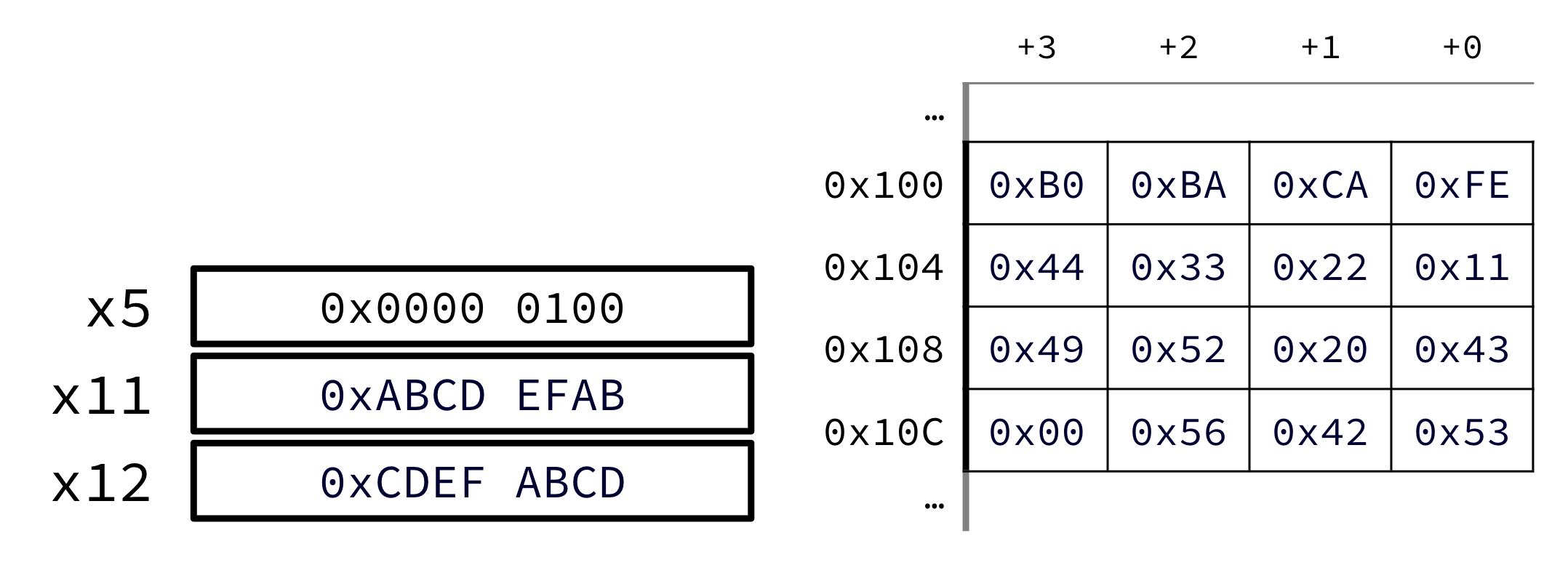
Starting memory layout for Example 1.
Hint: See the section on pseudoinstructions like li.
Show Answer
R[x12] is 0xFFFF FF93.
Explain `li x11 0x93F5`
Load Immediate (li rd imm) is addi rd x0 0x93F5. The pseudoinstruction therefore maps to addi x11 x0 0x93F5, so set R[x11] (the value of register x11) to the bits 0x000093F5.
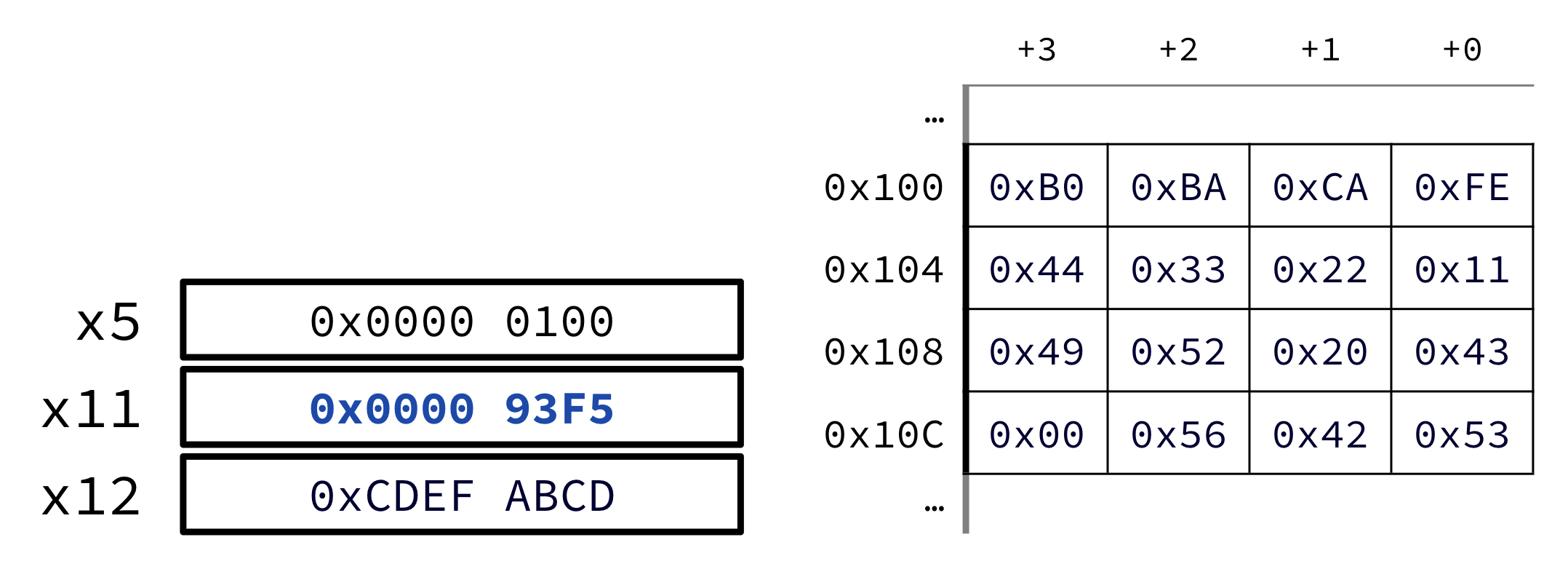
Solution (1/3) for Example 1.
Explain `sw x11 0(x5)`
Compute memory address as base register + offset, or R[x5] + 0 = 0x100 + 0 = 0x100. Store R[x11] (the value of x11) to memory at address 0x100. On this (assumed) little endian architecture, 0xF5 gets stored at the lowest byte 0x100.
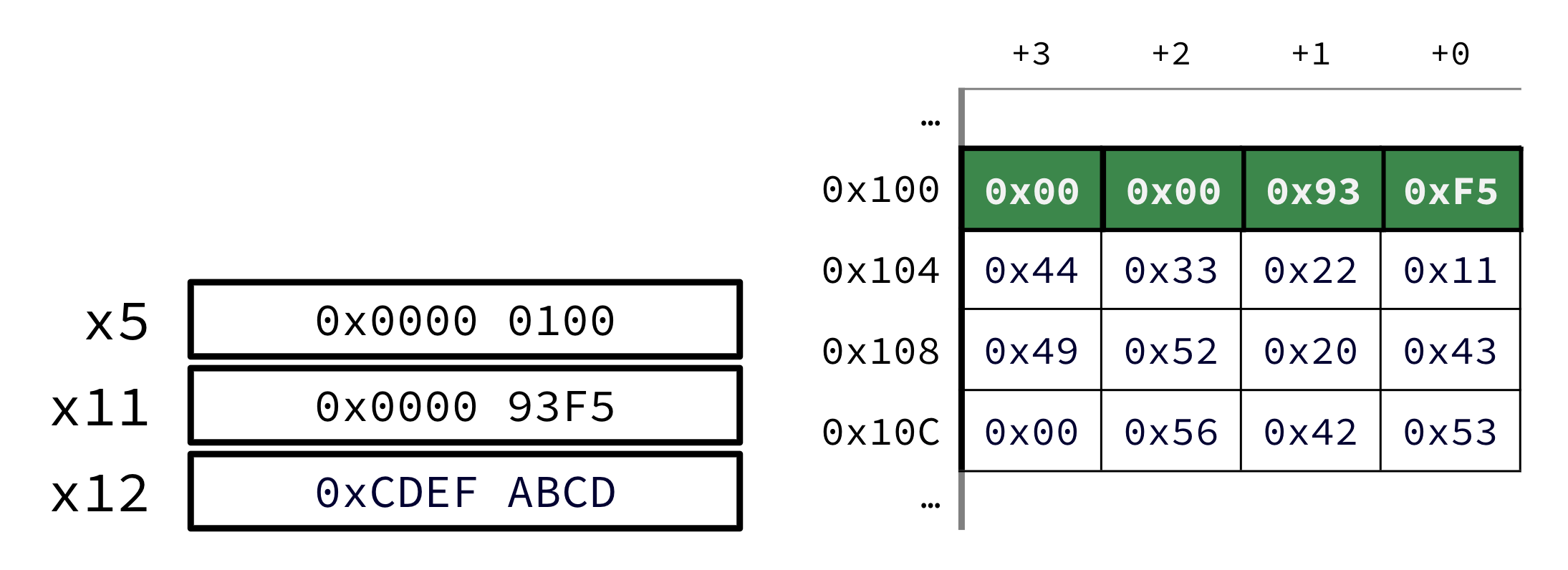
Solution (2/3) for Example 1.
Explain `lb x12 1(x5)`
Compute memory address as base register + offset, or R[x5] + 1 = 0x100 + 1 = 0x101. Load byte 0x93 from memory at address 0x101 into the lowest byte of register x11.
lb means we must sign-extend. The top bit of 0x93 is 1, so fill top 24 bits with 1s:
0x93 = 0b1001 0011
 0b1…1 1001 0011
 0xFFFF FF93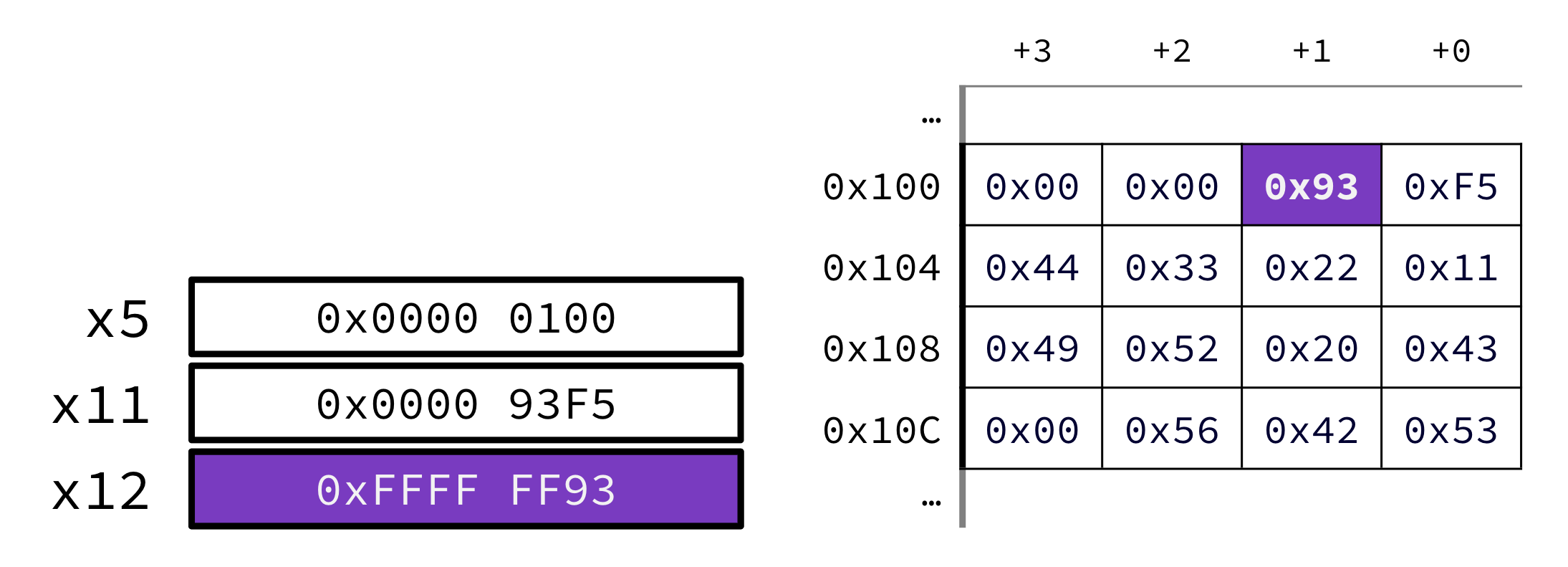
Solution (3/3) for Example 1.
Solution: R[x11] (the value in x11) is 0xFFFFFF93.
Example 2
Suppose that x and y are int * pointers whose values are in registers x3 and x5.
How do we translate the statement *x = *y; into assembly?
Consider the following instructions:
- add x3 x5 zero
- add x5 x3 zero
- lw x3 0(x5)
- lw x5 0(x3)
- lw x8 0(x5)
- sw x8 0(x3)
- lw x5 0(x8)
- sw x3 0(x8)
And consider the following choices:
- A. 1
- B. 2
- C. 3
- D. 4
- E. 5 → 6
- F. 6 -> 5
- G. 7 → 8
- H. Something else