RISC-V Arithmetic Instructions II: Bitwise Operations
Learning Outcomes
- Write assembly to perform bitwise operations.
- Understand why there are only three RISC-V bitshift operations:
sll,srl, andsra(and their immediate equivalentsslli,srli,srai).
🎥 Lecture Video
We recommend reviewing the C Bitwise Operations before continuing.
We have previously discussed that in RISC-V, operations determine “type,” i.e., how register contents are treated (see this table). Next, we will see how this concept applies to RISC-V’s instruction set for bitwise operations.
Bitwise Operations
As before, bitwise operations are performed on n-bit operands one bit at a time.
The RV32I ISA provides instructions for common bitwise operations.1. #tab-bitwise shows that most bitwise operations correspond to two instructions:
- RISC-V: Register. Perform the bitwise operation on two register operands
rs1andrs2, and store the result in a destination registerrd. - RISC-V: Immediate. Perform the bitwise operation on one register operand
rs1and an immediateimm, and store the result in a destination registerrd.
In #tab-rv-bitwise below, hover over each footnote to jump to the corresponding section on this page.
The not pseudoinstruction
In RISC-V, bitwise NOT is a pseudoinstruction and corresponds to a bitwise XOR with the immediate -1:
Notes:
- A bitwise NOT of the value
R[rs1]is defined as a bitwise inversion of all 32 bits of registerrs1. - Recall from our discussion of XOR properties that for a single bit
x, the expressionx XOR 1(x ^ 1) invertsx. - The immediate
-1has 32-bit two’s complement signed integer representation0b 1111 1111 1111 1111 1111 1111 1111 1111.
These three notes together explain #fig-rv32i-not below.
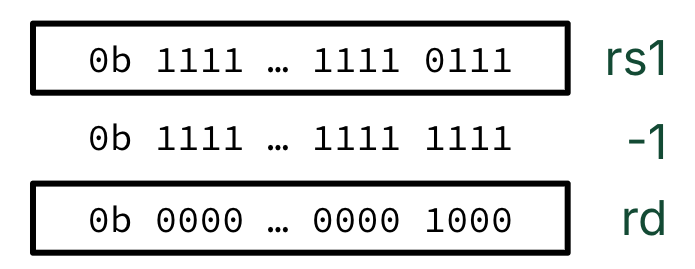
Add immediate instruction in RISC-V and C with negative values.
Show explanation
- The source register
rs1has value0b 1111 1111 1111 1111 1111 1111 1111 0111. - Destination register
rdhas value0b 0000 0000 0000 0000 0000 0000 0000 1000. - By definition, this operation is both NOT (a bitwise inversion) and XOR with the 32-bit two’s complement representation of
-1.
Shift left
Like all RISC-V arithmetic instructions, the left-shift operation sll must write all 32 bits of the destination register. Recall our discussion of the left shift operation: the expression x << n shifts the bits of x left by n bits, filling the n lower bits with zero. The sll operation therefore fills in these new bits with 0.
Shift right
Recall our discussion of the right shift operation: the expression x >> n shifts the bits of x right by n bits, filling the n lower bits with zero or one. In C, this was determined by x’s type. In RISC-V, the instruction determines what the lower bits are filled in with
srl, or Shift Right Logical (srlifor immediate). “Zero-extend” and fill the upper bits with0. This instruction effectively interprets registerrs1’s contents as an unsigned integer. Read more in an earlier section.sra, or Shift Right Arithmetic (sraifor immediate). Fill in the upper bits with the sign bit of registerrs1. This instruction effectively interprets registerrs1’s contents as a signedinteger. Read more in an earlier section.
shift arithmetic: signed
Other RISC-V arithmetic instructions
General multiplication is not included in the base RISC-V ISA but is specified as part of common RISC-V extensions. See the mul instruction on the RISC-V green card.
The circuitry for general multiplication is significantly more complicated than the bitwise left- and right-shift operations discussed above. For similar reasons, we do not discuss division, modulo, and floating point operations.5
Practice
Show answer
B. 0x3400.
These instructions are the RISC-V translation of the C practice example when we discussed C bitwise operations. We recommend reviewing that first.
Each line, explained:
-
Write value
0x000034FFto registerx10. -
R[x10] << 0x10is0x34FF0000. Write this value to registerx12. -
R[x12] >> 0x8is0x0034FF00because the sign bit ofR[x12]is initially0. -
R[x12] & R[x10]is0x000034FF & 0x0034FF00is0x00003400. See #fig-bit-shift from the C practice example.
Footnotes
-
See the full set of arithmetic instructions on the RISC-V green card. ↩
-
See the
notpseudoinstruction. ↩ -
See shift left. ↩
-
See shift right. ↩
-
We encourage you to read the RISC-V unprivileged ISA for the M Extension and the F extension. ↩