Summary
And in Conclusion
In order to pipeline, we separate the datapath into 5 discrete stages, each completing a different function and accessing different resources on the way to executing an entire instruction. Recall the five stages:
- In the IF stage, we use the Program Counter to access our instruction as it is stored in IMEM.
- Then, we separate the distinct parts we need from the instruction bits in the ID stage and generate our immediate, the register values from the RegFile, and other control signals.
- Afterwards, using these values and signals, we complete the necessary ALU operations in the EX stage.
- Next, anything we do in regards with DMEM (not to be confused with RegFile or IMEM) is done in the MEM stage,
- Finally, we hit the WB stage, where we write the computed value that we want back into the return register in the RegFile.
These 5 stages, divided by registers, allow operating different stages of the datapath in the same clock period.
- Different instructions can use different stages at the same time. At each clock cycle, the necessary inputs into a particular stage are sampled at the rising clock edge (and available after the clk-to-q delay).
- After the stage operates on the inputs, the corresponding outputs are fed into pipeline registers for the next stage. Pipeline registers may also be required to pass information that may not be necessary for the next immediate stage, but some future stage.
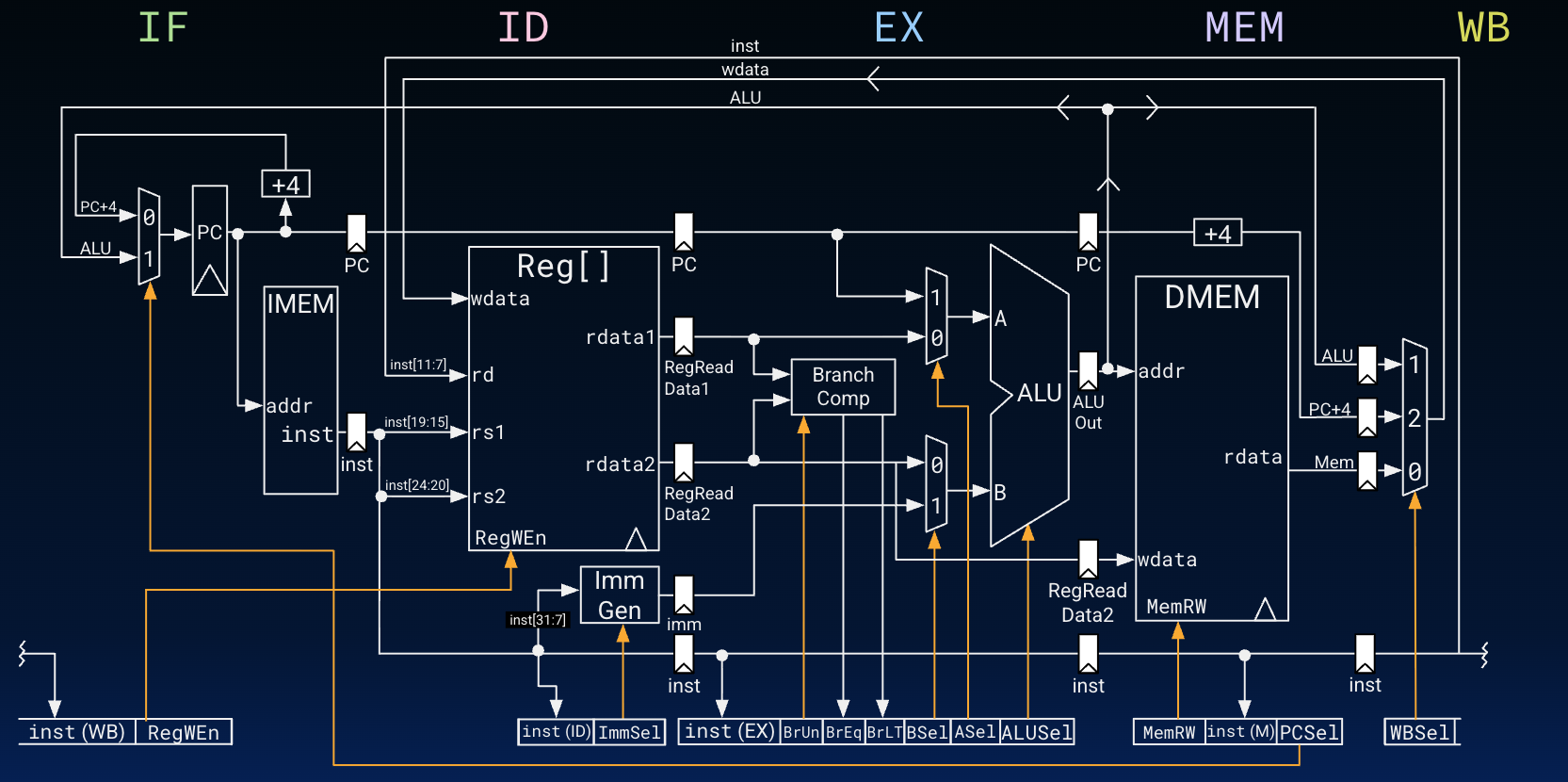
Five-stage RISC-V processor diagram: datapath and control.
The RISC-V ISA is designed for pipelining:
- All instructions are 32 bits wide.
- Easy to fetch (
IF) and decode (ID), each in one clock cycle. - Contrast with CISC (Complex) x86: 1- to 15-byte-wide instructions!
- Easy to fetch (
- A small set of standard instruction formats.
- Can decode/read registers in one stage (2nd,
ID).
- Can decode/read registers in one stage (2nd,
- Load/store addressing conceptually:
- Calculate address in 3rd stage (
EX) with ALU; and
- Calculate address in 3rd stage (
- Access memory in one stage (4th,
MEM).- Memory operands are all aligned
- Memory access takes only one cycle.
Textbook Readings
P&H 4.6, 4.7, 4.8
Additional References
Exercises
Check your knowledge!
Short Exercises
Solution
False. Because we insert registers between each stage in the datapath, the time it takes for an instruction to finish execution through the 5 stages will be longer than the single-cycle datapath. A single instruction will take multiple clock cycles to get through all the stages, with the clock cycle based on the critical path (the stage with the longest timing).
Solution
True. Recall that throughput is the number of instructions processed per unit time. Pipelining results in a higher throughput because multiple instructions can be in a different stage of the datapath at the same time.